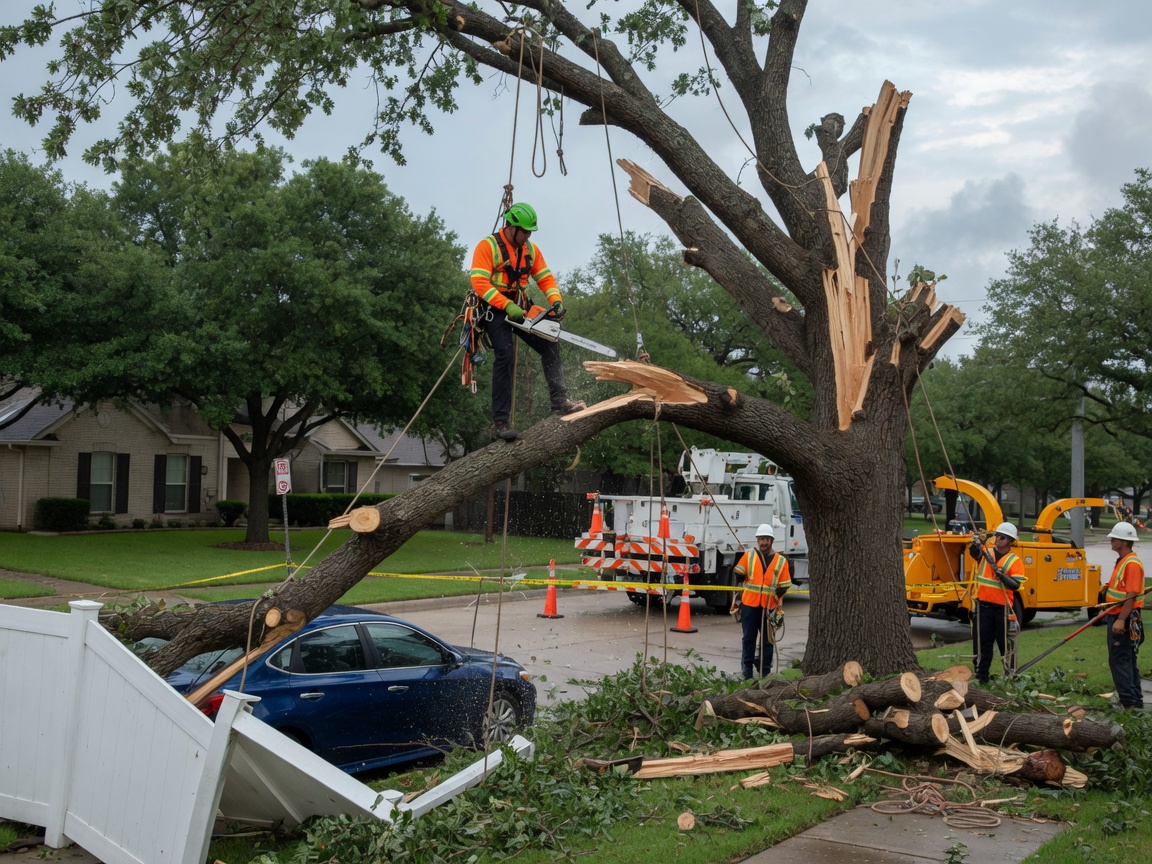
Anna is its own Collin County town on the north side of US 75, not a Plano subdivision, and the tree work shows it. Older blocks near the historic core sit on smaller lots with mature post oak, cedar elm, and hackberry, while newer streets off Ferguson Parkway are lined with fast-growing ornamentals planted when the houses went in. We run those jobs from 820 Jupiter Rd in Plano, coming up the highway rather than treating Anna like a West Plano cul-de-sac.
Blackland clay here shrinks in a dry summer and turns slick after a hard rain, so a stump that looks simple in July can bog a machine in spring. Mild winters still leave room for the occasional severe storm that rides the US 75 corridor and twists Bradford pears and topped live oaks. Access is the other constraint: alleys and short driveways near downtown Anna rarely take a large chip truck the way a wide new subdivision street will.
Tree removal is the call when a trunk is split, leaning over a roof, or too close to the line for a safe trim. Trimming is what we do when the canopy is still sound but rubbing the house, blocking a school-zone sightline, or shedding limbs every storm. Quotes are upfront, and you can walk the drop zone with us before any cut. Hours are Monday–Friday 8am–6pm and Saturday 9am–2pm.
Around Anna
We regularly work near:
- 📍Sherley Heritage Park
- 📍Slayter Creek Park
- 📍Anna High School
- 📍Ferguson Parkway
- 📍US 75 through Anna
- 📍White Street near downtown Anna
Tree Removal in Anna — Local Notes
- •Historic-core lots in Anna often have one large shade tree filling the side yard, so removal is usually a sectional takedown rather than a full fell into an open lawn.
- •Newer Anna subdivisions on expansive clay see foundation-adjacent roots and sidewalk heave; we plan stump depth around irrigation lines that were laid shallow when the streets were built.
- •Storm exposure along the open prairie north of the older grid means wind-loaded canopies fail at old topping cuts, especially on Bradford pear and hackberry.
- •After heavy rain the blackland soil will not hold outriggers the way sandy ground does, so wet-day jobs near Slayter Creek need mats and a smaller footprint.