2026-09-29 ·
Signs Your Tree Needs Removal After a North Texas Storm
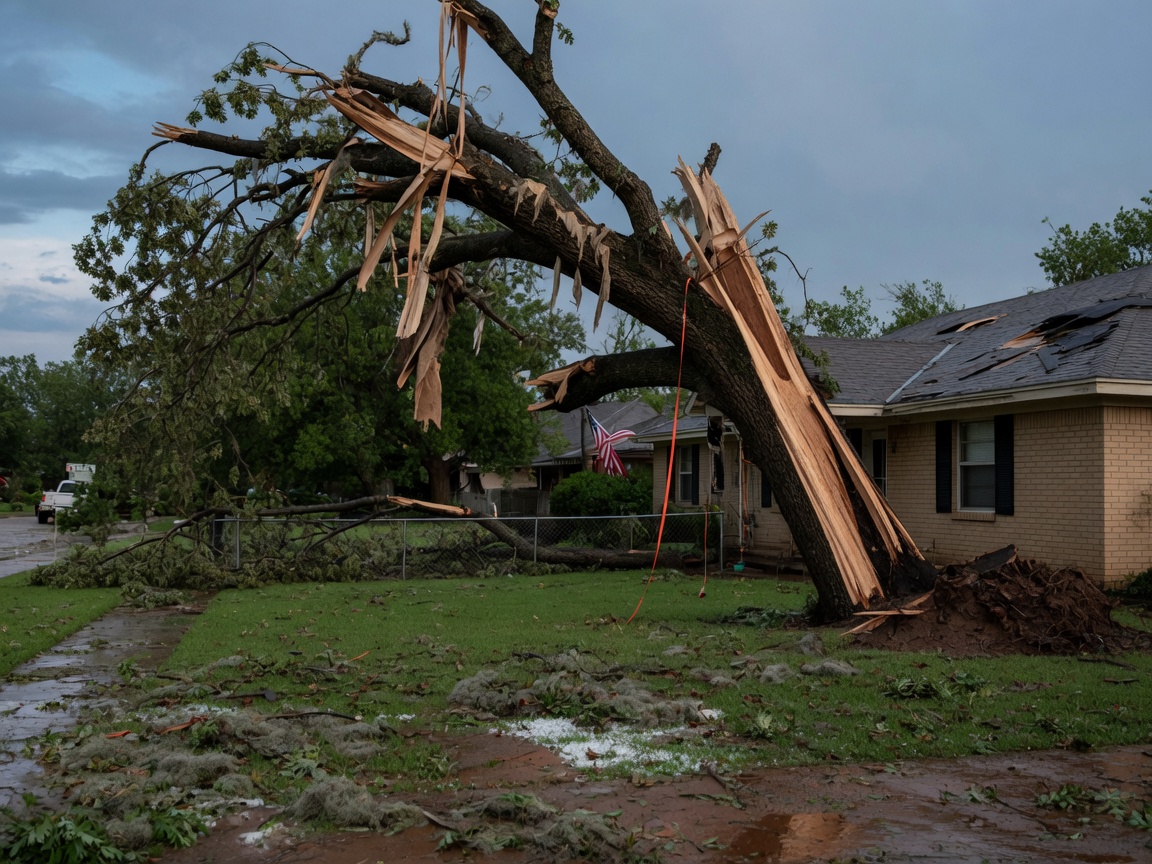
After a North Texas storm, a tree needs removal when the trunk is split, the root plate has lifted, more than about half the live canopy is gone, or a new lean exceeds roughly 15 degrees toward a house, driveway, or power line. Wind moving through Collin County does not have to lay a tree flat to ruin it. Hot summers already stress live oaks, red oaks, cedar elms, and pecans on Plano lots, and a severe storm stacked on that stress often leaves a tree upright that will fail on the next gust. Mild winters do not close structural wounds. In Legacy West and around Legacy Town Center, tight setbacks mean a cracked leader over a patio is not a wait-and-see problem. The same is true along Willow Bend, in West Plano cul-de-sacs, and on older East Plano streets where mature canopies hang over roofs. If you see the signs below, treat the tree as unstable until a climber has read it from the ground and, only when it is safe, from the crown.
Splits, Cracks, and a New Lean
Look at the trunk before you count broken twigs. A vertical crack that opens after wind, especially one running from a crotch toward the soil, means the wood fibers have separated and are no longer sharing load. Two stems that used to meet in a tight union and now show a dark seam, or a strip of fresh light-colored wood, have started to pull apart. A lean that appeared overnight is not the gradual lean you have lived with for years. Sight it against a door frame or a fence post. If the trunk has shifted past about 15 degrees, or if that lean points at a bedroom, a carport, or the sidewalk, removal is usually the honest call rather than a cable and a hope.
Hanging bark, a trunk that sounds hollow when you tap it, and sap bleeding from a fresh seam are supporting clues, not the whole case. Downtown Plano and the blocks near the Plano Convention Center mix street trees with private yard trees. A city tree in the parkway is not yours to cut, but a private tree leaning into that right-of-way still puts your roof and a neighbor's car in the failure path. Do not climb a split tree for a better look, and do not stand in the root zone if the soil has heaved. Keep kids, pets, and parked cars outside the drip line until the wood is on the ground. A tree that still has green leaves can be structurally finished.
Root Plate Lift on Plano Clay
Plano sits on clay that shrinks through long hot summers and softens fast when a storm dumps rain. That cycle is why root failure shows up as a mound on one side of the trunk and a crack or gap on the other. If the root plate has lifted about 2–3 inches or more, or you can see roots that were underground yesterday, the tree has already started to uproot. A stake and a guy wire will not seat that plate again. Oak Point Park's creek edges show the same pattern in a wilder form: saturated soil, then wind, then whole trees lying with a soil pancake still attached to the roots.
On residential lots in West Plano and East Plano the failure is smaller and the target is closer — foundations, gas meters, fences, and AC condensers. Circling roots from an old container planting, common in 1990s and 2000s subdivisions toward Frisco and Richardson as well as inside Plano, often fail at the flare rather than deep in the ground. After the storm, walk a full circle at a safe distance. Fresh soil on the lawn, a suddenly taller side of the flare, irrigation heads pushed out of grade, or a new crack in a nearby sidewalk are field signs, not cosmetic mess. A tree that is still vertical but whose root system has slid is as dangerous as one already on the roof.
Canopy Loss Versus a Trimming Job
Not every broken limb means the tree comes out. A single hanger over the driveway, or outer twigs stripped by hail and wind, is often a tree trimming job once the weather settles and the crown can be read in daylight. Removal is the better call when live canopy loss passes about 50%, when a main leader is gone and the remaining crown is lopsided over a structure, or when torn limbs leave wounds larger than about one-third of the trunk diameter. Those wounds do not close cleanly on a tree heading into another hot Plano summer, and decay starts in the tear long before the leaves tell you.
Hangers — limbs still attached by a strip of bark — are the injuries people underestimate. They can drop hours or days later with no new wind. If a hanger is larger than about 4 inches in diameter and sits over a walk, a play set, or a parking pad near Legacy Town Center townhomes, do not park under it and do not pull it down with a rope from the ground. That is how second injuries happen. When the tree is already on a house or blocking a street, access matters more than a perfect prune. That is the practical difference between scheduled tree removal and emergency tree removal. If the trunk and roots are sound and crown loss stays under roughly one-third, a proper reduction can keep the tree.
The First 24–48 Hours
Photograph the tree, the target, and the street from a safe distance before anyone starts cutting. Note the time of the storm and whether water is still standing. In Collin County, saturated clay plus a second round of wind is a common reason a tree that looked mostly fine fails the next afternoon. Keep vehicles out of the fall zone, at least the height of the tree in every direction. If limbs are on a power line, stay back and call the utility. Do not cut near energized wire, and do not let a ladder touch a limb that could roll onto the line.